

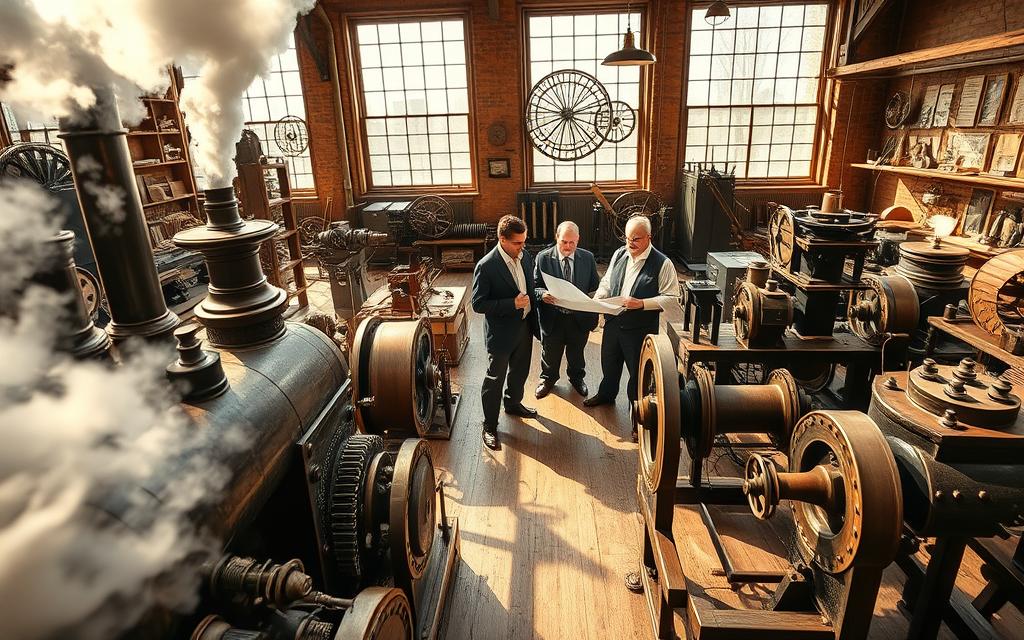
The Industrial Revolution changed human history by turning farming societies into industrial economies. This major period lasted from the mid-eighteenth to the nineteenth century. It grew from scientific knowledge, engineering advances, natural resources, and more than one invention.
It began in Britain, then spread across Europe and the United States. Industrial Revolution inventions included steam engines, mechanized textiles, and new methods for making iron and steel. These changes reshaped manufacturing, transportation, and communication.
Empirical science supplied principles and measurements, while technology turned them into practical machines and systems. These scientific advances drove economic growth and social change. How did science and technology contribute to the industrial revolution? They reshaped commerce, agriculture, and everyday life.
Key Takeaways
- The Industrial Revolution was a complex interaction of various factors, not just one invention.
- Key developments included steam power, mechanized textiles, and iron manufacturing.
- Britain was the initial center of industrialization before it spread globally.
- Scientific principles guided technological advancements that transformed industries.
- This era significantly impacted manufacturing, transportation, and communication.
The Scientific Foundations of the Industrial Revolution
The Industrial Revolution grew from more than technological advances. It also rested on a powerful scientific awakening. This era brought Enlightenment science, empirical thinking, and the scientific method.
People began to believe they could understand nature through observation and experiments. As Isaac Newton famously stated, “If I have seen further, it is by standing on the shoulders of giants.” His words show how earlier scientific achievements prepared the way for future inventions.
The Enlightenment and the Rise of Empirical Thinking
The Enlightenment promoted reason and evidence over tradition. Scholars and scientists explored ideas through systematic observation and experiments. Testing hypotheses with repeatable experiments created conditions for innovation.
Learned societies and universities helped share knowledge with a wider audience. These institutions built communities of thinkers who sought the laws of nature.
Key Scientific Disciplines That Drove Industrial Innovation
Several scientific fields drove industrial innovation. Mechanics guided machine design, while thermodynamics explained heat and power generation. Chemistry supported fuel development and manufacturing processes.
Metallurgy advanced the production of stronger materials. Mathematics enabled precise design and measurement in engineering. Natural philosophy helped explain motion and energy, supporting many inventions.
Related Posts:






Many early industrial inventors were practical experimenters, not formally trained scientists. They thrived in an environment with increasingly systematic knowledge. Together, empirical thinking and applied science enabled steady technical progress and transformed the Industrial Revolution.
The Steam Engine: Powering a New Era
The steam engine shaped the Industrial Revolution and changed how industries worked. Thomas Newcomen developed it, and James Watt improved it for manufacturing and mining. This technology became a powerful force in industrial progress.
In 1769, James Watt introduced the separate condenser, a major improvement. It kept the main cylinder hot while steam condensed in another chamber. This improved fuel efficiency, made steam power more commercially useful, and encouraged wider industry use. Watt’s partnership with Matthew Boulton helped spread the engine across many industries.
James Watt and the Separate Condenser
James Watt’s separate condenser reduced the coal needed to run steam engines. This improvement let engines run longer without constant refueling. Industries relied more on steam power, which especially helped coal mining technology.
Steam Power in Mining and Manufacturing
Steam engines changed coal mining by draining deeper mines effectively. This raised coal production, which fueled other industries and increased demand for coal. Steam power also freed factories from water sources, giving them more choices for locations and hours.
In textile mills, metalworking shops, and transportation, steam engines supplied reliable power. This helped create the factory system, where workers and machines operated under central management. Steam power did not quickly replace water power; both systems shaped factory mechanization.
Overall, steam engines transformed industries during the Industrial Revolution and shaped modern manufacturing. Their impact continues today, showing the lasting legacy of this remarkable invention.
Textile Industry Innovations: From Hand to Machine
The textile industry stood at the center of the Industrial Revolution and changed production forever. Demand for affordable cotton cloth grew, so inventors created machines to meet it. These inventions included the spinning jenny, water frame, power loom, and cotton gin.
The Spinning Jenny and the Water Frame
James Hargreaves invented the spinning jenny in the 1760s, letting one worker spin multiple yarn spindles at once. It raised yarn output, although the yarn remained relatively weak. It boosted textile industry productivity and became one of the first machines supporting mechanized textile production.
Afterward, Richard Arkwright developed the water frame, which used water power to make stronger yarn. It improved yarn quality and encouraged larger mills with centralized labor. These mills housed more workers and machines, becoming textile production centers that improved efficiency.
The Power Loom and the Cotton Gin
Edmund Cartwright invented the power loom in the late 18th century. It mechanized weaving and allowed faster cloth production. Early versions needed more work, but the machine later became essential in factories, raising fabric output and speed.
Meanwhile, Eli Whitney invented the cotton gin in the 1790s, transforming cotton processing in the United States. It separated cotton fibers from seeds far faster than manual labor, greatly increasing cotton supplies. It made cotton cheaper and more available, causing a boom in textile exports and factory employment.
These innovations had complex effects. Mechanization brought mass production and urbanization, but it increased demand for raw cotton. In the American South, this demand reinforced the plantation slave economy and reshaped ties among manufacturers, workers, and global suppliers.
During the Industrial Revolution, advances in the textile industry laid the foundation for modern manufacturing. Mechanized spinning and weaving increased production speed and changed labor organization and the era’s economy. To learn how technology evolved through history, visit this link.
Iron and Steel Production: Building the Modern World
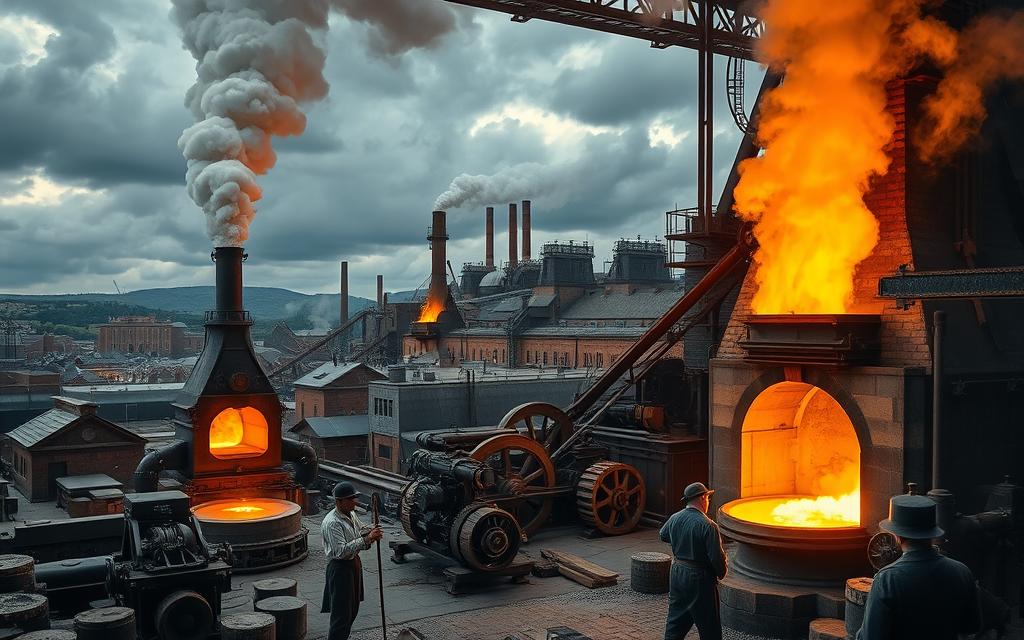
Metallurgy innovations helped build factories and cities during the Industrial Revolution. Iron production grew as industrialization rapidly expanded, and iron and steel became essential materials. They made tools, machinery, railways, and bridges, changing the nineteenth-century landscape.
Abraham Darby made a major advance by using coke in blast furnaces. This method reduced charcoal use and supported larger-scale iron production. Greater iron output prepared the way for later steelmaking innovations.
The Bessemer Process and Mass Steel Production
Henry Bessemer changed steelmaking with the Bessemer process, which helped create mass steel production. By forcing air through molten pig iron, it removed impurities and made quality steel quickly and cheaply.
It greatly cut production time and costs, but precise control was needed. Later, open-hearth production expanded steelmaking capacity and made steel more available for many uses.
Iron Bridges and Industrial Architecture
Advances in iron and steel enabled major projects, including the iconic Iron Bridge over the River Severn. These iron bridges showed the materials’ strength and flexibility. Industrial architecture also changed cities as iron-framed factories, railway stations, and warehouses filled urban areas.
These innovations allowed longer spans, taller buildings, and heavier machinery. Durable, striking buildings transformed cities and supported growing transportation networks and the demands of a growing industrial economy.
| Material | Production Method | Key Feature |
|---|---|---|
| Iron | Coke Smelting | Reduced reliance on charcoal |
| Steel | Bessemer Process | Quick and cost-effective production |
| Iron Bridges | Engineering Innovations | Enabled longer spans |
| Industrial Architecture | Iron Framing | Stronger, taller structures |
Transportation Revolution: Connecting Nations
The Industrial Revolution sparked a transportation revolution that connected nations more closely than ever before. New inventions cut travel times and shipping costs, linking regional markets and speeding industrial expansion.
The steam locomotive was one of this era’s most transformative inventions. These powerful machines grew from earlier mine and colliery engines into reliable railway systems. George Stephenson, often called the “Father of Railways,” showed their commercial potential on the Liverpool and Manchester Railway, opened in 1830.
Railways linked coalfields, ports, industrial cities, and agricultural districts, moving raw materials and finished goods. This network standardized regional time and encouraged tourism and migration. As one historian noted, railway expansion increased demand for iron, coal, engineering, and construction.
“The railway was the lifeblood of the Industrial Revolution, fueling economic growth and social change.”
Equally important were steamships, which reduced reliance on wind power and made ocean travel more predictable. Advances in iron hulls, screw propellers, and marine engines transformed maritime transport. Steamships shortened routes, supported regular schedules, and greatly expanded international commerce.
These vessels connected producers with distant markets and moved goods efficiently across the globe. However, integrated transportation also aided imperial expansion and intensified competition for resources and markets. Steamships changed trade and reshaped the period’s geopolitical landscape.
The transportation revolution became a cornerstone of the Industrial Revolution, linking economies and societies in unprecedented ways. To learn more about industrialization’s broader impacts, visit this resource.
Communication Breakthroughs: The Telegraph and Beyond
The electric telegraph marked a major communication breakthrough during the Industrial Revolution. It carried messages faster than any available method. Samuel Morse developed a practical system and Morse code, changing long-distance communication.
Samuel Morse’s electric telegraph sent electrical pulses through wires as coded messages. Inventors and engineers in Europe and the United States helped create this method. Fast information flow made business communication more efficient, helping businesses operate effectively.
Samuel Morse and the Electric Telegraph
Samuel Morse made major contributions to the electric telegraph. His Morse code offered a simple, effective way to send messages across telegraph networks. It supported personal communication and expanded business operations during the Industrial Revolution.
Impact on Business Coordination and Information Flow
The telegraph changed business coordination in important ways. Manufacturers, merchants, banks, newspapers, and railway companies exchanged information quickly, monitored prices, placed orders, and coordinated shipments. This made companies more responsive to market conditions.
The telegraph also improved railway safety and scheduling. Dispatchers could contact stations directly, lowering collision risks and improving efficiency. News agencies used it for faster reports and growing national and international information networks.
The telegraph did not replace transportation; it supported railways and steamships. By coordinating their movements, it connected industrial systems more closely. This made those systems more responsive to the growing economy.
Agricultural Mechanization: Feeding the Industrial Age
Agricultural mechanization greatly increased agricultural productivity during the Industrial Age. As cities grew, people needed more food, so farmers developed new methods. It helped secure food supplies and support the growing industrial workforce.
The seed drill, developed by Jethro Tull, planted seeds at precise depths and intervals, improving germination over hand scattering. Scientific crop rotation, especially the Norfolk four-course system, protected soil, reduced fallow land, supported livestock, and improved farm efficiency.
Moreover, the mechanical reapers, linked to Cyrus McCormick, changed harvesting. The mechanical reaper and the threshing machine separated grain from chaff more efficiently than manual methods, using advanced threshing machines. Farmers harvested larger fields faster, reducing labor costs and increasing output.
Mechanization spread at different speeds across regions. Larger farms adopted it quickly, but smaller farms often used traditional methods and animal power. Despite this difference, mechanization lowered food costs and increased agricultural productivity.
Greater efficiency helped populations grow and encouraged rural-to-urban migration. With fewer farm jobs, many workers sought work in emerging industries, transportation, and services. Agricultural mechanization transformed farming and played a crucial role in shaping the Industrial Revolution’s labor landscape.
Chemical Industry Advances: Foundations of Modern Manufacturing
The chemical industry became a foundation of the Industrial Revolution through science-based, large-scale manufacturing. Chemistry became vital in factories, consumer goods, medicine, and public health.
The Leblanc process, developed by Nicolas Leblanc in the late 18th century, transformed manufacturing. It made soda ash from common salt, sulfuric acid, limestone, and coal. Soda ash production supported glassmaking, soap production, bleaching, paper manufacturing, and textiles.
Yet the Leblanc process also exposed industrial pollution’s dangers. Byproducts of soda ash production often contaminated the environment, showing the conflict between growth and public health.
The Leblanc Process and Soda Ash Production
The Leblanc process enabled mass soda ash production, which was once scarce. This change deeply affected manufacturing:
| Industry | Use of Soda Ash |
|---|---|
| Glassmaking | Essential for producing glass products |
| Soap Production | Key ingredient in creating soap |
| Textiles | Used in dyeing and bleaching fabrics |
| Paper Manufacturing | Improves the quality of paper |
Synthetic Dyes and Early Pharmaceutical Innovation
Another breakthrough was the development of synthetic dyes, beginning with William Henry Perkin’s accidental discovery of mauveine in 1856. This discovery gave textile makers more colors than natural dyes offered.
Laboratory experiments and chemical patents helped synthetic dyes grow. Chemists and manufacturers worked together, creating a market for bright colors and transforming textiles.
The chemical industry also advanced early pharmaceutical innovation. Scientists isolated, purified, and synthesized active compounds, helping shape modern medicine. Clinical standards were less strict than today, but these efforts laid the groundwork for pharmaceutical chemistry.
During the Industrial Revolution, chemical advances created new markets, specialized jobs, and technical education. Chemistry pushed industry beyond mechanical production, shaping materials science, consumer products, and environmental engineering.
How Did Science and Technology Contribute to the Industrial Revolution: A Comprehensive View
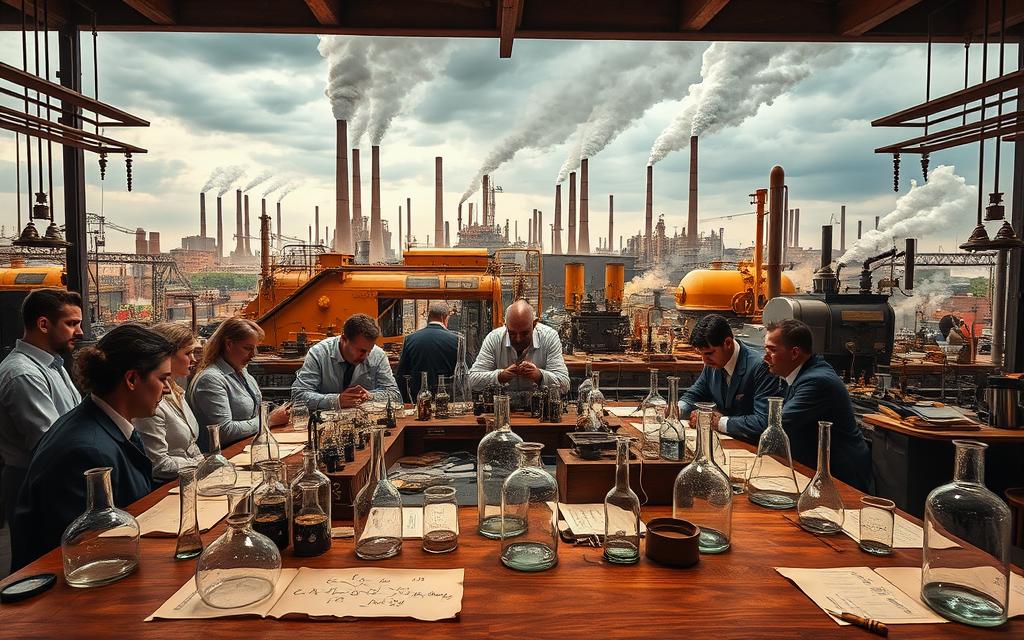
Science and technology contribution shaped the Industrial Revolution through a strong partnership between research and invention. Scientific theories guided tools, while engineering problems encouraged the practical application of science.
The steam engine changed transportation and encouraged deeper studies of heat and energy. The factory system demanded advanced metallurgy because railway and machinery construction needed stronger materials. Chemistry grew with large-scale manufacturing, producing synthetic dyes and better chemical processes.
Electricity principles supported commercial communication through telegraphy, improving business coordination. Skilled mechanics, patent holders, investors, entrepreneurs, factory managers, and workers adapted inventions for practical use.
The Interplay Between Scientific Theory and Practical Application
Advancing scientific theories created a feedback loop with technology. Engineers solved practical problems through innovation, encouraging scientific exploration and creating a framework for future industrial advances.
Long-Term Economic and Social Transformations
Industrial Revolution economic transformation increased productivity and lowered unit costs, expanding markets and encouraging industrial specialization. Wage labor became common, corporate growth surged, and international trade increased greatly.
Social transformation was equally significant. Rapid urbanization created working-class communities and expanded middle-class employment opportunities. Family roles changed, while industries increased demand for skilled labor and technical education.
Dangerous workplaces, long hours, and child labor were widespread, alongside overcrowded housing and pollution. The unequal distribution of wealth and colonial exploitation worsened these problems. This included the expansion of slavery-connected cotton production.
The Industrial Revolution eventually encouraged labor organizing, factory regulation, public health reforms, compulsory education, and infrastructure investment. Science and technology were powerful tools, but institutions, labor systems, public policy, and economic power shaped their results.
Conclusion
This Industrial Revolution summary explains a major shift in human history, driven by the impact of technology and science. Innovations transformed production, making it more powerful and easier to expand. Steam engines supplied flexible mechanical power and fueled industrial development across many sectors.
Textile machinery changed factory production, while advances in iron and steel made durable infrastructure possible. Railways and steamships connected markets, supporting trade and communication. The telegraph sped information flow and changed business operations and coordination.
Agricultural machines helped secure food supplies and allowed workers to move. The chemical industry expanded manufacturing and introduced new consumer goods. Together, coal, capital, skilled labor, and growing populations formed a system that increased demand in modern industrial society.
Industrialization raised productivity and created economic systems, but it also caused exploitation and environmental damage. The history of science and technology shows how science explained natural forces and technology used those ideas to change life. Together, they reshaped economies and established institutions linked to today’s modern industrial society.